
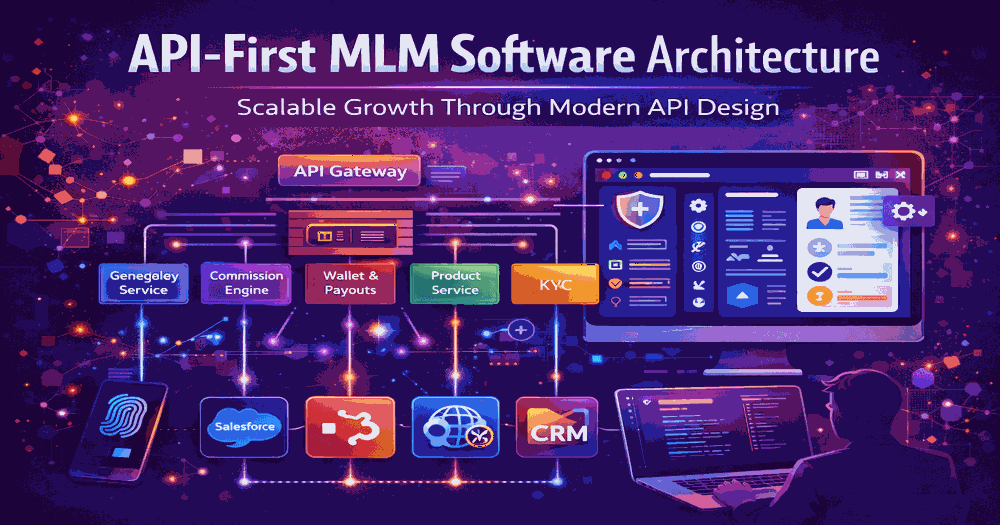
A modern MLM platform can’t thrive on a monolithic codebase or outdated integration patterns. An API-first MLM software architecture ensures your system scales effortlessly, connects with any tool in your ecosystem, and delivers a seamless experience for distributors and customers. It’s the backbone that lets fast-growing MLM companies stay flexible, compliant, and innovatively ahead.
MLM businesses are no longer operating in walled digital gardens. They rely on external CRMs, global payment gateways, mobile apps, analytics dashboards, tax engines, KYC services, warehouse systems, and social commerce platforms. The result: complexity that multiplies as fast as the network itself.
In a traditional monolithic MLM system, each new integration becomes a custom project—long timelines, fragile connectors, and endless maintenance debt. When the business grows, the software often chokes on its own dependencies.
An API-first architecture flips the model. Instead of adding APIs as afterthoughts, APIs become the central product. Every service—from genealogy to payout engines—exposes clean, documented endpoints that other systems can consume. This gives MLM enterprises the agility to:
In a fast-moving industry where innovation speed directly affects retention and revenue, API-first is not a luxury. It’s a strategic requirement.
The first principle of API-first architecture is modularization. Break down the platform into independent services with their own responsibilities—Commission Engine, Genealogy Service, Wallet & Payouts, Product Catalog, Compliance & KYC, etc.
Why this works for MLM?
A real-world scenario:
When an MLM brand enters a new Asian region, the payout engine must adapt to local tax rules and payment types. In a modular setup, you update or swap only that service—without touching genealogy logic or distributor APIs.
Architecture example:
[API Gateway]
    |
    |---- Genealogy Service
    |---- Commission Engine
    |---- Wallet & Payout Service
    |---- Product & Order Service
    |---- User & Auth Service
    |---- Notification Microservice
This structure also supports cloud-native autoscaling, essential for peak traffic events like flash sales or rank-qualification periods.
API-first only works when developers—internal and external—can use your APIs without friction. Clear documentation is not a bonus feature; it is part of the product itself.
Key elements of DX-focused API design:
Imagine a scenario where a partner marketing agency wants to build a custom distributor onboarding workflow using your APIs. With excellent documentation, their development time shrinks from weeks to days, strengthening your ecosystem and reducing integration costs.
MLM impact:
Better DX → Faster integrations → More distributor tools → Higher engagement and retention.
MLM systems handle everything financial—wallets, payouts, commissions, tax reports—and everything personal—KYC data, addresses, identity documents. An API-first architecture enforces standardized security across all endpoints, making it far easier to maintain robust protection.
Security best practices for MLM APIs:
MLM companies expanding internationally face constantly evolving rules—GST in India, VAT in the EU, SSN verification in the US. With a decoupled API-driven compliance layer, the system adapts without rewriting core code.
Example:
A global MLM brand integrating with a new EU tax engine can simply plug into a dedicated Compliance API rather than refactor every payout and invoice workflow.
Distributors aren’t using a single interface anymore. They’re navigating:
Without an API-first foundation, every channel becomes a separate engineering nightmare. With it, all channels consume the same core logic.
Benefits:
Think of it as “write once, deploy everywhere” for MLM features—ensuring a frictionless and unified distributor experience.
Prime MLM Software was built from the ground up with an API-centric philosophy. Rather than treating APIs as integration add-ons, the platform exposes nearly every function—genealogy, orders, commissions, payment wallets, rank rules, and reporting—through secure, well-documented endpoints.
How this translates into real business benefits?
This approach empowers ambitious MLM companies to innovate quickly, experiment with new digital sales tactics, and scale infrastructure at the pace their networks demand.
An API-first MLM architecture isn’t just a tech choice—it’s a strategic edge. It gives growing networks the ability to integrate faster, innovate more freely, maintain system stability, and stay compliant across markets. As the industry moves toward AI-assisted selling, global e-commerce, and mobile-first operations, the companies that invest in flexible, API-driven foundations will dominate the next decade of growth.
Common questions about API-first MLM software architecture and its impact on scalability, security, and growth.
It’s an architecture where APIs serve as the core foundation, enabling modularity, integrations, and multi-channel access.
It allows faster scaling, smoother integrations, and more flexible technology growth.
It powers unified data across apps, dashboards, and social selling tools.
Yes—companies can plug in regional payment gateways, tax engines, and KYC tools quickly.
Strong authentication, consistent policies, and audit-ready services make it inherently more secure.
Absolutely—clean documentation and stable endpoints make external development easier.
Yes—apps pull real-time data directly from modular services.
Upfront cost may be higher, but long-term savings in flexibility and maintenance are significant.
Prime exposes core MLM functions through secure, comprehensive APIs for easy integration and customization.
Yes—starting API-first ensures they can scale without re-platforming later.