
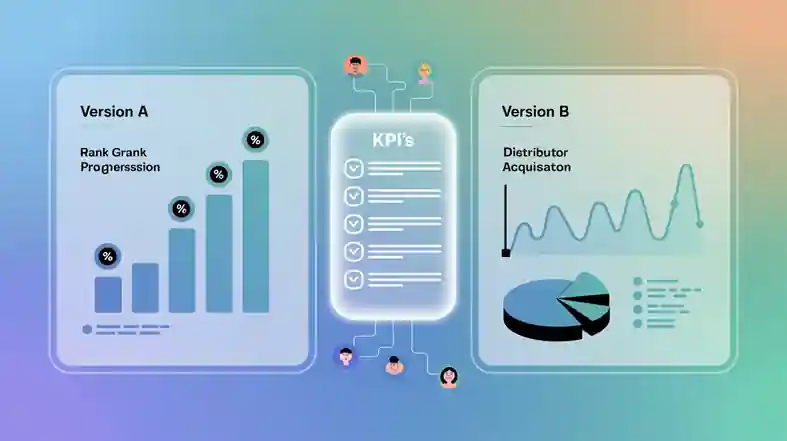
Changing an MLM compensation plan is a high-stakes decision. Without data-backed testing, even a small tweak can lead to distributor churn or financial instability. To avoid the “thin content” trap and rank higher, this guide explores how to scientifically validate your plan updates using A/B testing and a rigorous KPI framework. 🚀
In the context of Multi-Level Marketing, A/B testing (or split testing) involves running two versions of a compensation rule or incentive structure simultaneously (usually via simulation or a pilot group) to see which performs better against your business goals. This ensures that your “New Plan” is actually an “Improved Plan.”
Before launching a change globally, isolate a segment of your network or use historical data as a baseline (the “Control”). The “Test” group receives the new variable—such as a higher fast-start bonus or a modified matching bonus.
To know exactly what caused a shift in behavior, only change one element. If you change both the withdrawal limit and the binary cap at the same time, you won’t know which one impacted your retention.
Monitor these Key Performance Indicators (KPIs) to determine the success of your A/B test:
Many MLM companies fail their A/B tests because they don’t account for Seasonality (e.g., testing during December holidays) or External Market Trends. Always ensure your test duration is long enough to cover at least two full commission cycles. 📉
Don’t test on live distributors if you can help it. Use advanced MLM simulation tools to run “What If” scenarios against your real-world data from the past 12 months. This allows you to see the financial impact without risking your reputation. ✨
A: Ideally, a test should run for 60 to 90 days. This allows you to observe behavior over multiple payout cycles and account for monthly fluctuations.
A: Yes, but be careful of “artificial” growth. Ensure that a higher recruitment bonus doesn’t negatively impact the quality of product sales or long-term retention.
A: While it varies by industry, most sustainable MLM plans aim for a 35% to 45% payout ratio. If your A/B test pushes this to 60%, your company’s long-term viability may be at risk. ⚖️
A: Transparency is key. Once the A/B test proves successful, use data from the test to show distributors exactly how the change will benefit their earnings and stability.
