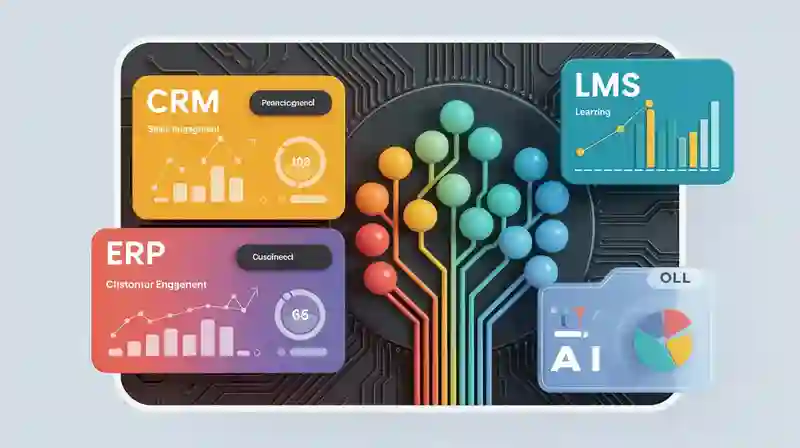
MLM businesses thrive on large networks, fast growth, and continuous distributor engagement — but managing leads, commissions, logistics, and training across hundreds or thousands of members can quickly become chaotic without the right tools. That’s why modern MLMs need CRM (to manage relationships and recruitment), ERP (to streamline operations, inventory, and payouts), and LMS (to train and retain distributors). Together, these systems create a powerful, automated ecosystem that drives transparency, efficiency, and scalability — turning complex network marketing operations into data-driven, growth-ready enterprises.
In an era where network-marketing (also called multi-level marketing, MLM) companies are scaling across geographies and digital platforms, the technology stack behind them must evolve too. To stay agile, transparent and efficient, MLM firms are increasingly integrating three critical enterprise systems — Customer Relationship Management (CRM), Enterprise Resource Planning (ERP) and Learning Management Systems (LMS) — with their dedicated MLM/Compensation-software platforms. In this article we’ll deep-dive into how this integration works, why it matters, what the market data says, and what trends are shaping the future.?
In this article we’ll explore what signals indicate your business has outgrown a generic CRM, delve into real-time market statistics, and map out the latest industry trends that make specialized MLM software the winning choice.
Unlike a standard sales operation, an MLM business has:
Distributor networks (downlines, uplines, genealogy trees, multi-tier compensation plans)
Complex commission logic (binary, matrix, unilevel, hybrid), overrides, volume calculations
Multi-market/geography operations with different currencies/taxes/compliance
High churn risk among distributors and customers, requiring rapid onboarding & training
Large data flows: leads → enrolments → sales → commissions → fulfillment → reorders
A generic CRM or ERP alone will struggle to accommodate these demands. As one industry article notes:
“When your MLM business starts juggling complex downlines, multi-level commissions, and expanding markets, a standard CRM simply can’t keep up.”
Thus, integrating specialized MLM software with enterprise systems becomes essential for scalability, transparency, and operational efficiency.
CRM (Customer/Distributor Relationship Management): Tracks leads, contact history, distributor recruitment, customer engagement, follow-ups. For example, CRM integration helps “downline enrollment follow-up” in network marketing.
ERP (Enterprise Resource Planning): Manages back-office operations — inventory, logistics/fulfilment, finance, payroll/commissions, accounting, global compliance. For MLM, integration with ERP supports distributor payout, multi-currency, tax, inventory shipping, etc.
LMS (Learning Management System): Provides training, onboarding modules, distributor education, compliance training, customer product education. Integration with CRM/MLM software helps align learning paths with distributor status, customer journey and product knowledge.
When CRM + ERP + LMS are tightly integrated with MLM software, you get a unified ecosystem. Some of the benefits:
End-to-end visibility: one dashboard showing lead → enrolment → commission → training status → churn.
Improved onboarding speed: data flows automatically from lead to distributor to training assignment.
Reduced admin overhead: less manual patch-work, fewer spreadsheets, fewer errors. As one white-paper shows: companies with integrated MLM platforms see 28% cost reduction, 67% faster onboarding, 43% higher retention.
Enhanced data-driven insights: Segment distributors by training completion, performance, sales volume; cross-reference with CRM data and ERP financials.
Scalability and compliance: Integration supports expansion into new geographies, currencies, languages, regulatory regimes, without manual patchwork.
A white-paper on MLM integration reports that companies with a well-integrated ecosystem (MLM + auxiliary systems) achieved 3.2× greater growth scalability.
A market analysis article says integration with CRM/ERP/LMS is now a strategic rather than optional design decision for MLM businesses.
LMS market data: The retail LMS software market is experiencing rapid growth driven by training/upskilling and integration demands.
A trend article observes that “LMS platforms are prioritising API-based integrations with HR systems, workforce automation tools, and CRM platforms” in 2025.
The essential integrations blog for MLM says: “Integrating CRM with your direct selling software allows you to track customer interactions, manage leads, and optimise communication.”
These benchmarks underline the importance of integration as an investment in growth and efficiency, not just a “nice to have”.
| Metric | Before Integration | After Integration |
|---|---|---|
| Administrative cost for distributor onboarding | Baseline | ~ 28% reduction (reported) |
| Onboarding time for new distributors | Slow, manual | ~ 67% faster (reported) |
| Distributor retention | Lower | ~ 43% higher in integrated case |
| Scaling ability (markets/countries) | Limited | ~3.2× higher growth potential |
Modern platforms are built with open APIs to integrate CRM, ERP, LMS seamlessly, reducing custom code. The MLM integration white-paper emphasises modularity and cloud-native architecture.
LMS is no longer isolated. Integrated learning and performance data (from CRM) drives personalised onboarding/training for distributors & customers. Eg: “An LMS integration with a CRM like Salesforce can personalise learning paths …”
MLM businesses are expanding across languages, currencies, regions. Integration with ERP/CRM handles multi-currency payouts, tax compliance, localization, cross-border shipping. The challenges article emphasises this as a major area.
With integrated systems, companies can apply AI/ML to predict distributor churn, forecast sales by leg, recommend training modules, optimize commissions. The LMS/CRM integration article mentions analytics capabilities.
For network marketing businesses, speed of onboarding, quality of training, and distributor experience become key to retention. LMS integration ensures that from day-one, a new distributor has assigned training, sees their downline, gets CRM-driven outreach. The LMS trend article notes micro-learning, mobile learning as key.
Define the data flows clearly: Map lead → contact → enrolment → sales → commission → training progression. Identify where each system feeds in.
Maintain a single source of truth: Avoid data silos. Distributor data, customer data, commission data, training completion — all need consistent identifiers.
Prioritise real-time dashboards: Downline performance, training completion, sales volume, churn—should be visible to stakeholders in near-real time.
Focus on user experience: For distributors, the interface should feel seamless – training, commissions, chats, sales portal, everything tied to their CRM/MLM dashboard.
Plan for compliance and global operations: E-wallets, multi-currency, tax/regulation changes – integrate with ERP modules or third-party compliance tools.
Train your team on change management: Integration is not just technical—it requires adjusted processes, new roles, data governance.
Pilot before full rollout: Choose a segment (region, product line) to test integration before scaling globally.
Imagine a direct-selling company with global operations across 10 countries, offering health-supplement subscriptions via MLM compensation plans. Here’s how integration plays out:
A lead is captured via marketing and enters the CRM.
The CRM triggers follow-up workflow and also passes lead to MLM platform once they convert to distributor.
The MLM platform assigns them into the compensation plan, records their genealogy, tracks their first order.
The ERP manages inventory, invoicing, shipping and commission payouts across currencies.
The LMS assigns a 30-day onboarding course, product knowledge modules, and records completion.
Analytics components combine data from CRM (lead source, conversion rate), MLM (downline growth), LMS (training completion rate), ERP (first month volume) and produce a dashboard showing risk of churn, top performers, etc.
Based on this integrated view, the company identifies that distributors who complete training within 7 days of enrolment have 35% higher retention, enabling targeted interventions.
Whether you’re a startup MLM business or an established network marketing enterprise, integration of CRM, ERP and LMS with your MLM software is no longer optional—it’s a strategic imperative. The market is being shaped by:
Rising expectations from distributors for a seamless digital experience
Global expansion requiring robust systems and compliance
The need to measure, optimise and monetise training, onboarding and downline performance
The growing cost of inefficiency, manual work and data silos
By integrating, you unlock higher retention, faster growth, lower admin costs and better visibility into your business. As one white-paper concluded: integrated platforms deliver 3.2× greater scalability
.
The successful MLM enterprises of tomorrow will be those that treat technology not as a set of disparate tools, but as a connected ecosystem: CRM for relationships, ERP for operations, LMS for capability-building — all integrated with MLM software that handles the unique dynamics of network marketing. If you’re still running isolated spreadsheets, manual commission calculations or disconnected training platforms, now is the time to future-proof your business.
It’s the process of connecting customer, business, and learning systems with MLM platforms to automate distributor management, sales, and training.
CRM integration helps track leads, manage customer relationships, and streamline distributor onboarding for faster growth and retention.
It enables automated commission calculations, inventory management, and multi-currency transactions, ensuring smooth back-office operations.
LMS systems deliver product training, onboarding courses, and compliance education to distributors, boosting engagement and retention.
In 2025, AI-driven analytics, cloud-native APIs, and modular microservices are shaping the future of integrated MLM ecosystems.
They create a unified digital ecosystem: CRM manages leads, ERP handles logistics, and LMS empowers distributors with knowledge.
Integrated systems can increase scalability 3.2×, reduce onboarding time by 67%, and improve distributor retention by 43% (Epixel report).
Modern SaaS-based solutions offer modular APIs, making CRM, ERP, and LMS integration affordable even for small MLM ventures.
Select vendors offering open APIs, real-time dashboards, and experience in multi-tier compensation logic and compliance management.
The future is data-driven — AI-powered insights, real-time dashboards, and gamified training experiences will define next-gen MLM systems.
👉 Try the official MLM Software Demo for Your MLM Business
and experience what MLM Software looks like when it’s powered by the best.
💌 Or, check out our blog
to compare top direct-selling companies, get insider reviews, and learn how to grow your income ethically in the wellness niche.